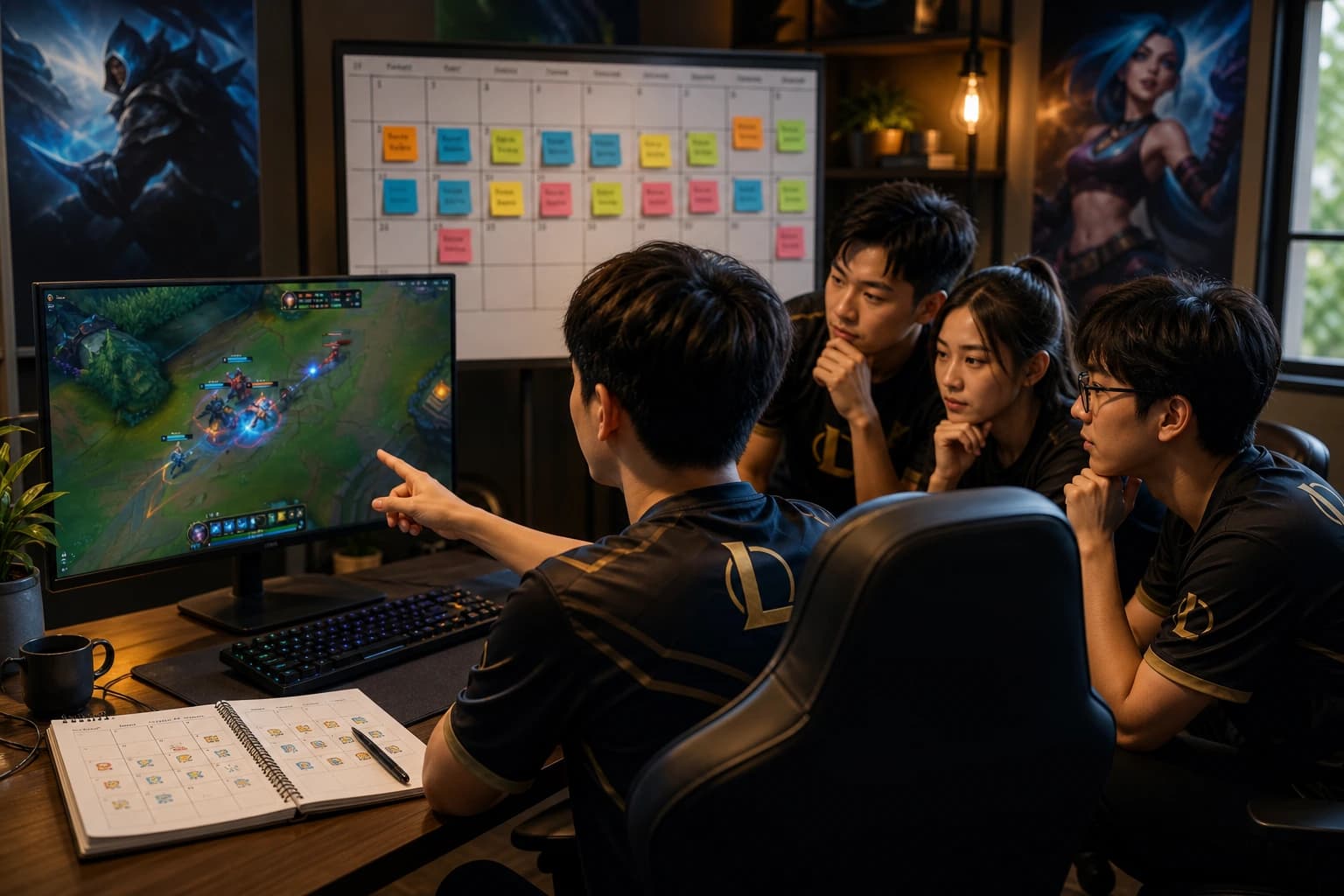

17 League of Legends tips for 2026: Climb Smarter With the Right Squad
Improving at League takes more than copying a build or spamming ranked. These practical League of Legends tips combine mechanics, macro, review habits, mindset, and measurable practice plans, while showing how compatible teammates on COYA can make learning and climbing more consistent.

Improving at League takes more than copying a build or spamming ranked. These practical League of Legends tips combine mechanics, macro, review habits, mindset, and measurable practice plans, while showing how compatible teammates on COYA can make learning and climbing more consistent.
At COYA, we see improvement as more than gaining LP. It is about understanding your decisions, building repeatable habits, and playing with people who support the way you learn. These League of Legends tips are designed for new and intermediate players worldwide who want a practical route from inconsistent games to calmer, smarter ranked sessions.
The 17 League of Legends tips in this guide cover fundamentals, champion selection, mechanics, macro, role-specific priorities, practice plans, VOD review, tilt management, and teammate compatibility. You do not need to master everything at once. Pick one focus for your next three games, measure it, and only add another when the first habit starts feeling automatic.
The 17-tip roadmap
Learn the win condition, farm safely, check the minimap, choose one role, limit your champion pool, warm up, manage waves, use a macro checklist, convert leads, adapt by rank, train role priorities, run a 7-day sprint, follow a 30-day plan, track useful metrics, review VODs, use stop rules, and find compatible teammates.
Start with the fundamentals that win League games
The first of our League of Legends tips is simple: remember what wins the game. Your team must destroy the enemy Nexus, and champions are only tools for gaining access to it. Gold buys power, XP unlocks levels, waves create pressure, and neutral objectives help your team control space. A flashy kill matters less if it costs two waves, a tower, or an uncontested Dragon.
Tempo describes who can act first with useful resources. If you clear a wave, recall, buy, and return before your opponent, you may create a window to ward, roam, or contest an objective. If you remain on the map with low health and unspent gold, you are technically present but often unable to contribute. Good recalls are therefore part of good macro.
Prioritize farming, survival, and useful map movement
Among the most reliable League of Legends tips for early improvement is to prioritize guaranteed value. Last-hit without taking unnecessary damage, trade when your key abilities are available, and avoid chasing through unwarded terrain. For many developing laners, consistently reaching 6 CS per minute is a useful initial target. More experienced players can aim toward 7 or 8 when the matchup and game state allow it.
- Farm first when no urgent fight or objective requires your presence.
- Recall after pushing a wave when possible, rather than leaving minions to die at your tower.
- Move only when the likely reward exceeds the XP, gold, and pressure you surrender.
- Treat every avoidable death as lost tempo, not only a change to your KDA.
Turn the minimap into a decision-making tool
Useful League of Legends tips should change what you physically do during a match. Build a minimap check into moments when your champion is not demanding precision, such as after taking a last hit or while an ability animation completes. Look for missing opponents, visible wards, wave direction, objective timers, and your jungler's location. Checking every few seconds is a training goal, not a rigid law.
Communicate missing enemies early and use concise pings instead of flooding the screen. A compatible teammate makes this habit easier because you can agree on simple signals before queueing. COYA helps players meet others who value communication without turning every normal mistake into a blame session.
Choose a role and champion pool you can actually master
The next League of Legends tips concern identity rather than raw mechanics. Your best role is not automatically the one with the most popular champions. Choose according to the decisions you enjoy making, the responsibility you want, and the type of pressure you handle well. Compatibility matters in champion choice and teammate choice alike.
Match your playstyle to the five roles
- Top suits players comfortable with independent laning, matchup knowledge, side-lane pressure, and timely teamfight entry.
- Jungle suits strategic players who enjoy pathing, tracking opponents, creating number advantages, and directing objective setups.
- Mid rewards adaptable players who want lane control, burst opportunities, roaming windows, and influence across both sides of the map.
- ADC fits patient, mechanically consistent players who enjoy scaling, precise positioning, and dealing sustained damage with team protection.
- Support suits team-focused players who enjoy vision control, lane coordination, engage timing, peeling, and enabling another carry.
Use these League of Legends tips as a starting point, then test each promising role across several normal games. One rough match says little. Look for the role where you remain curious after losing and can explain what you want to improve next.
Build a small, reliable champion pool
For ranked, choose one main champion, one backup with a similar role identity, and one mechanically simple fallback. A three-champion pool gives you matchup familiarity without leaving you helpless after a ban. Constantly switching may feel productive, but it forces you to relearn ranges, damage thresholds, wave clear, and teamfight execution.
These League of Legends tips do not mean ignoring balance changes. Check whether an update fundamentally changes your champion, then adjust deliberately. Mastery usually matters more than chasing every short-term trend. Regular COYA teammates can also learn your champion's engage windows and preferred pacing, making repeated practice more valuable.
Practice mechanics and macro together
Mechanics let you execute a decision, while macro helps you select the right decision. Effective League of Legends tips connect both. Perfecting a combo has limited value if you start it while outnumbered, and a strong objective call fails if nobody controls the wave or arrives with enough health and mana.
Use a short daily mechanics routine
Before ranked, spend about 15 focused minutes warming up. Use five minutes for last hitting without abilities, five for movement and your champion's core combo, and five for camera movement, skill shots, attack commands, or defensive spacing. Keep the routine specific enough to score.
- Last hitting: record your CS at 5 and 10 minutes under repeatable practice conditions.
- Combos: complete 10 clean repetitions from both sides of the target.
- Skill shots: choose a fixed number of attempts and record successful hits.
- Camera control: move the camera to another lane and return without losing control of your champion.
- Attack commands: practice maintaining movement between attacks rather than standing still.
One of the easiest League of Legends tips to overlook is stopping the drill while you are still focused. Fifteen deliberate minutes can be more useful than an hour of autopilot. The goal is readiness, not exhaustion before the queue begins.
Learn wave management through three game states
Freeze when you want the wave near your tower, can prevent the opponent from safely farming, and do not need immediate priority elsewhere. Keep a small enemy minion advantage and avoid unnecessary area damage. This can protect you while behind or expose an opponent to a gank.
Slow push by keeping more allied minions alive across multiple waves. The growing wave can support a dive, create a recall window, or force an opponent to answer while your team moves elsewhere. Fast push by clearing immediately when you need priority for an objective, want to punish an opponent's recall, or must crash before resetting.
Apply these League of Legends tips through three questions: What does the wave look like? Where could the enemy jungler be? What objective becomes relevant next? A correct wave action depends on all three, not on a rule memorized without context.
Use a simple macro decision tree
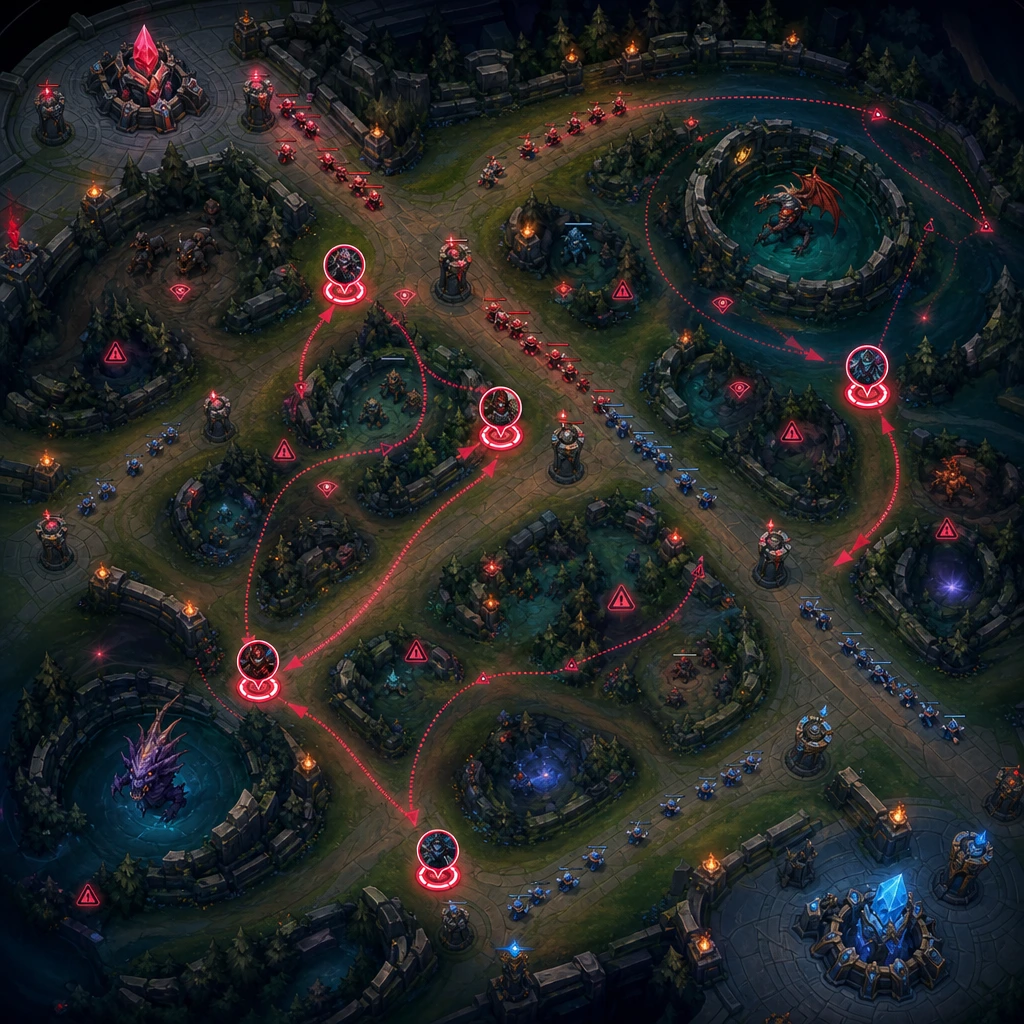
Before moving, check the wave state, visible enemy positions, objective timer, your health and mana, unspent gold, and teammate readiness. If ahead, use pressure to take safe territory and deny resources. If even, create priority before contesting. If behind, trade opposite-side resources, clear safely, and avoid low-percentage fights that expand the deficit.
A good call is not simply aggressive or passive. It matches the information, resources, and teammates available right now.
— COYA gameplay principle
Convert advantages into objectives
The most actionable League of Legends tips answer the question, "What next?" After a kill or winning trade, consider crashing the wave, taking a plate or tower, establishing vision, securing a neutral objective, stealing safe jungle resources, or recalling. Do not spend 20 seconds chasing another uncertain kill while the guaranteed advantage disappears.
Coordination makes conversion cleaner. A matched duo on COYA can agree that winning mid priority means moving together toward vision or an objective, rather than splitting into unrelated plays. Clear expectations reduce random solo moves and make post-game review more useful.
Adapt your improvement focus by role and rank
Not all League of Legends tips deserve equal attention at every level. Improvement is faster when you remove the biggest recurring leak first. A player dying eight times per match usually gains more from safer positioning than from studying advanced draft theory.
What to focus on from beginner levels through Silver
- Reduce avoidable deaths by reviewing where you lacked information or ignored a numbers disadvantage.
- Build toward a consistent CS baseline rather than comparing one unusually strong game.
- Ward before extending and use your available trinket instead of holding it indefinitely.
- Commit to one main role and a small champion pool for at least several sessions.
- Arrive for objectives on time, but do not abandon multiple waves for a fight that has already ended.
For these ranks, foundational League of Legends tips should feel almost repetitive. That is useful. Supportive players can reinforce the same plan across several games, which is why COYA matches by rank and playstyle rather than treating every person looking for a group as interchangeable.
What changes in Gold, Platinum, and beyond
As fundamentals stabilize, focus on tempo, matchup planning, cooldown tracking, and wave-to-objective transitions. Ask what the opponent wants to do before the lane starts. Track major mobility or defensive cooldowns during fights. Review repeated decision errors, such as late recalls before Dragon, rather than simply increasing match volume.
Role-specific priorities for your next matches
- Top: improve wave control, Teleport timing, side-lane safety, and the timing of your teamfight entry.
- Jungle: plan the first clear, track likely enemy pathing, identify strong lanes, and arrive early for objective setup.
- Mid: manage priority, place vision around roam routes, track opposing movement, and coordinate with your jungler.
- ADC: protect farm, track major threats, position around safe damage windows, and avoid entering fights first.
- Support: control vision with purpose, manage roam timing, recognize engage windows, and peel when engaging would expose your carry.
Role-specific League of Legends tips become easier to execute with complementary teammates. A top player may want a calm jungler who respects wave states, while an ADC may need a support with compatible aggression. COYA lets players connect around those preferences instead of hoping every random pairing shares the same plan.
Follow a measurable 7-day or 30-day improvement plan
Advice only becomes training when it has a schedule and a measurement. The following זה turn broad goals into two practical plans. Use the 7-day sprint to diagnose weaknesses, then continue with the 30-day plan if you want a more stable ranked routine.
The 7-day League improvement sprint
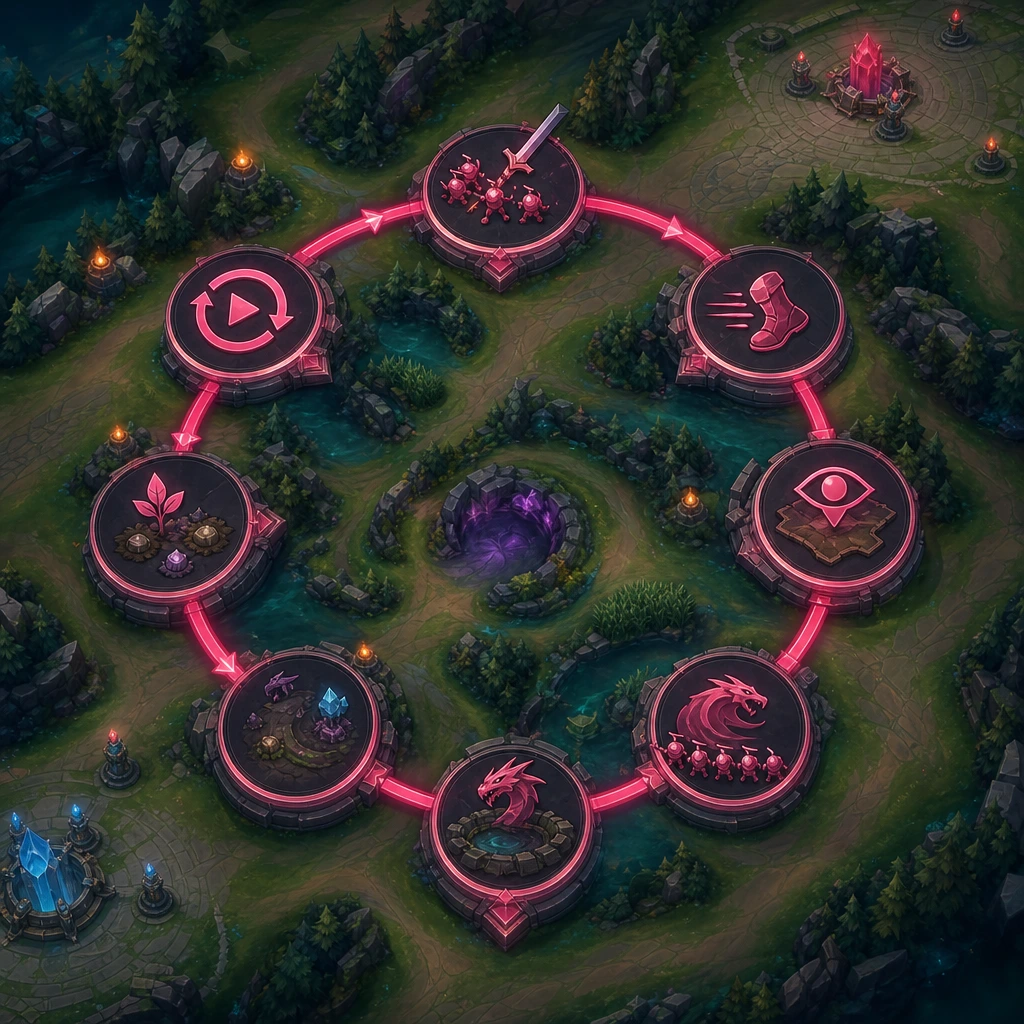
- Day 1, baseline: play two focused games and record CS per minute, deaths, vision score, objective participation, and your first avoidable mistake.
- Day 2, farming: complete a 10-minute CS drill, then play while prioritizing safe last hits and recall timing.
- Day 3, mechanics: practice your main champion's two core combos, movement pattern, and defensive response before two games.
- Day 4, awareness: check the minimap after last hits and record every death caused by missing information.
- Day 5, waves: intentionally create one freeze, one slow push, and one fast push when the game state supports each choice.
- Day 6, objectives: start planning 60 seconds before major objectives by fixing waves, recalling, buying, and establishing vision.
- Day 7, review: watch key moments from the week and identify one repeated mistake plus one decision that improved.
Do not judge the sprint only by wins. Better זה produce observable behaviors: fewer blind deaths, earlier objective preparation, cleaner recalls, and more stable farming. If you train with a COYA teammate, compare one metric after each session and keep the conversation focused on choices you can control.
The 30-day ranked climbing plan
Week one covers foundations: CS, survival, recalls, and minimap checks. Week two develops role and champion mastery through matchup notes and focused mechanics. Week three emphasizes macro execution, including waves, rotations, vision, and objectives. Week four builds ranked consistency with controlled sessions, review, and tilt boundaries.
- Play two or three focused ranked games per session rather than queueing until concentration disappears.
- Use one practice goal for the full session, such as arriving early for objectives or reducing pre-10-minute deaths.
- Review at least one short clip after each session and conduct one longer weekly review.
- Keep the same main role and champion pool unless there is a clear reason to adjust.
- Schedule a weekly check-in with regular COYA teammates to discuss coordination, communication, and shared goals.
These זה work best when the plan is sustainable. Thirty days of three thoughtful sessions per week can teach more than a burst of daily games played while tired. Consistency means preserving the quality of attention you bring to each match.
Track progress without obsessing over LP
LP is a delayed and noisy result. Track indicators that describe how you played: CS per minute, deaths before 10 minutes, recall quality, objective participation, vision usage, repeated errors, and one successful decision per game. Review averages across 10 or more matches instead of reacting to a single win or loss.
A compact post-game scorecard
Record your CS per minute, avoidable deaths, first recall timing, objective setup, vision usage, repeated mistake, and best decision. Add one sentence describing what you will repeat or change next game.
The strongest זה protect motivation by showing progress before rank fully reflects it. If deaths fall and objective preparation improves, your process is moving in the right direction even during a short losing streak.
Review smarter, manage tilt, and protect consistency
Ranked improvement depends on emotional control because frustration changes decision quality. Practical זה should help you recognize when learning has stopped. You do not need to feel perfectly calm, but you should be able to name your current focus and process new information.
Run a five-minute VOD review after each session
Review the first avoidable death, one missed objective setup, and one strong decision. For the death, pause several seconds earlier and identify the information you had. For the objective, check wave states, recall timing, and arrival order. For the strong decision, explain why it worked so you can reproduce it.
Avoid turning review into a search for teammate mistakes. COYA encourages shared learning, but a useful review still begins with controllable choices. A compatible duo can compare perspectives without treating feedback like a verdict on skill.
Use stop rules before tilt takes over
Pause after two frustrating losses, especially if you notice rushed queues, hostile chat, repeated blame, or abandoned practice goals. Stand up, drink water, move for a few minutes, and return only if you can state a clear intention. Muting distracting chat is a valid attention-management tool.
One of the healthiest זה is knowing that stopping is part of training. Protecting tomorrow's session is more valuable than forcing one more game while your decision-making is already compromised.
Why the right teammates can accelerate your progress

Some זה become dramatically easier when another player shares the goal. A consistent duo can coordinate recalls, track cooldowns, plan objective setups, and review misunderstandings after the match. The benefit is not guaranteed wins. It is a more stable environment for practicing decisions repeatedly.
COYA matches gamers based on their games, platforms, rank, age, and playstyle, then places compatible players in a live room so they can play together immediately. That means you can look for communication style and improvement mindset, not merely someone who happens to be online.
Find players who communicate and learn like you
A compatible teammate may be calm and analytical, highly competitive, aggressive in lane, or focused on relaxed improvement. The important part is alignment. COYA's promise is straightforward: Find Teammates Who Actually Fit Your Playstyle. When expectations match, objective calls become clearer and feedback is less likely to create unnecessary friction.
Turn solo goals into shared habits on COYA
Use COYA to find a jungle-mid duo for practicing roam timing, an ADC-support pairing for wave and engage coordination, or similarly ranked players for a weekly VOD routine. These are זה you can turn into shared commitments: one pre-game goal, concise in-game communication, and a short review afterward.
Your next climb starts with one focused game
You do not need 17 simultaneous goals. Choose one of these זה, define a measurable behavior, play a small set of focused matches, and review what happened. Then repeat with teammates who respect the same process. COYA brings compatible players together so improvement can feel social, structured, and more enjoyable. Your next squad is waiting on COYA.
Ready to Find Your Squad?